

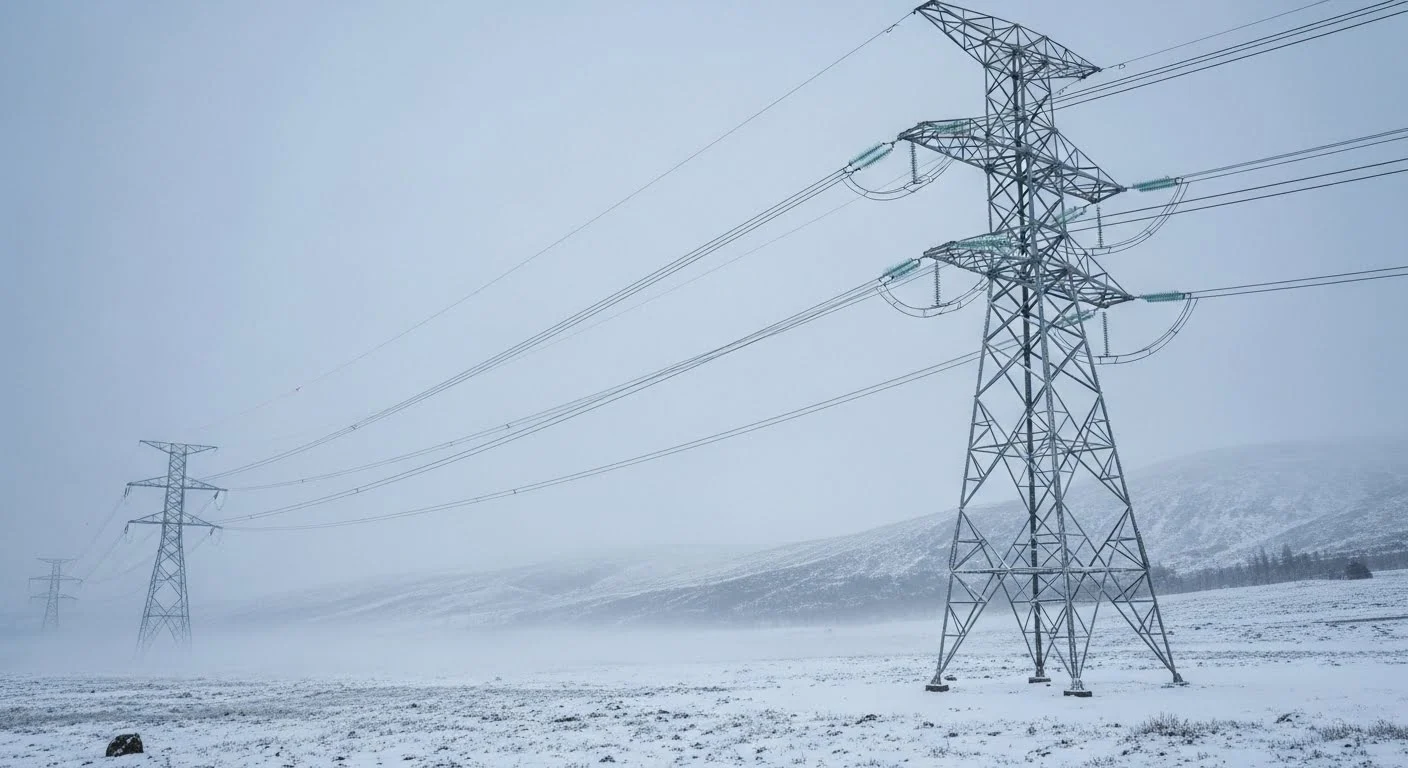
In the modern world, electrical energy is not just a means of comfort, but an indispensable “life support unit” for the sustainability of life. The energy that lights up cities, runs factories and sustains the digital world travels thousands of kilometers from generation plants to the end user. The silent carriers of this journey are the Energy Transmission Lines (ENH) and the steel poles that carry them.
From high mountain peaks to river crossings, from industrial zones to salty coastlines, these lines are exposed to nature’s most aggressive conditions. The biggest threat to engineering at this point is corrosion. When a pole rusts and loses its strength, it means not only the collapse of that pole, but also the collapse of the national electricity grid, the cessation of industrial production and millions of pounds of economic loss.
In this technical article, energy transmission polesin hot-dip galvanizingwe will examine with scientific data why the application of hot-dip galvanizing is not an aesthetic preference or option, but an “obligation” in terms of operational safety, public finance and engineering ethics.
Harsh Conditions and Corrosion Risk of Power Transmission Lines
When a lighting pole or city furniture is corroded, it can be easily painted or replaced. However, the situation is very different for High Voltage (HV) lines.
Atmospheric Corrosion Map (C1 to C5)
Energy lines know no geographical boundaries. A line can start from a plateau with clean air conditions (class C1), pass through a thermal power plant site with high sulfur gases (class C4) and end at a seashore with salt spray (class C5).
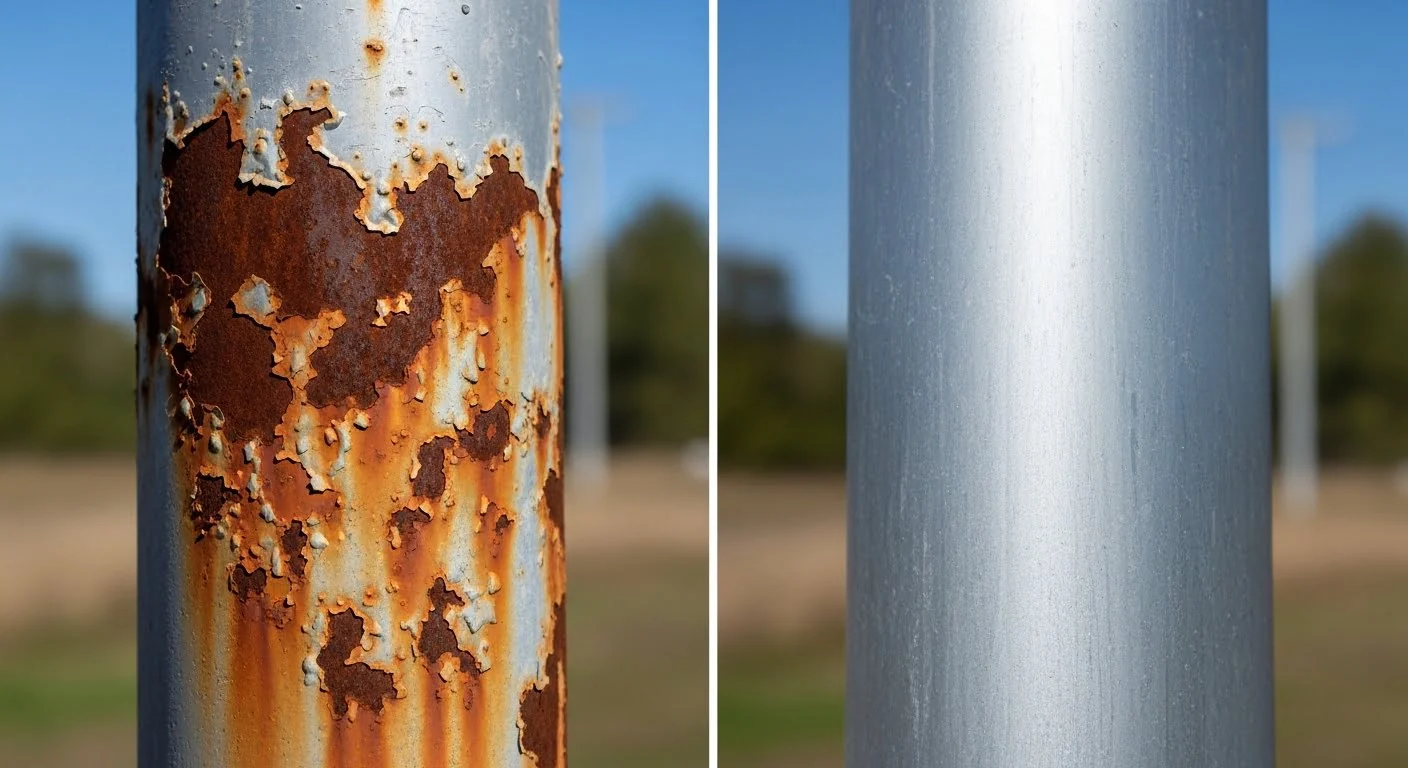
- Risk:Unprotected or only painted steel can lose between 80-200 microns of thickness per year in C4-C5 environments. A 10 mm wall thickness cage post angle iron is at risk of collapse, losing 20% of its static bearing capacity within 10 years.
Inaccessibility
The vast majority of power poles are located in mountainous areas where there is no vehicular access, in forests or in river beds.
- Maintenance Impossibility:It is technically and economically almost impossible to repaint a 50 meter high pylonpole at the top of a mountain without cutting off the power. Therefore, power transmission lines must be designed according to the “Fit and Forget” principle.
Static Load and Corrosion Fatigue
Power poles carry not only their own weight, but also kilometers of conductor wires, ice loads (sleeves) and wind pressure. The “pitting” caused by corrosion reduces the fatigue resistance of the metal. Under the constant vibration created by the wind, a corroded pole can break unexpectedly, even far below the calculated load.
The Metallurgical Superiority of Hot Dip Galvanizing Technology
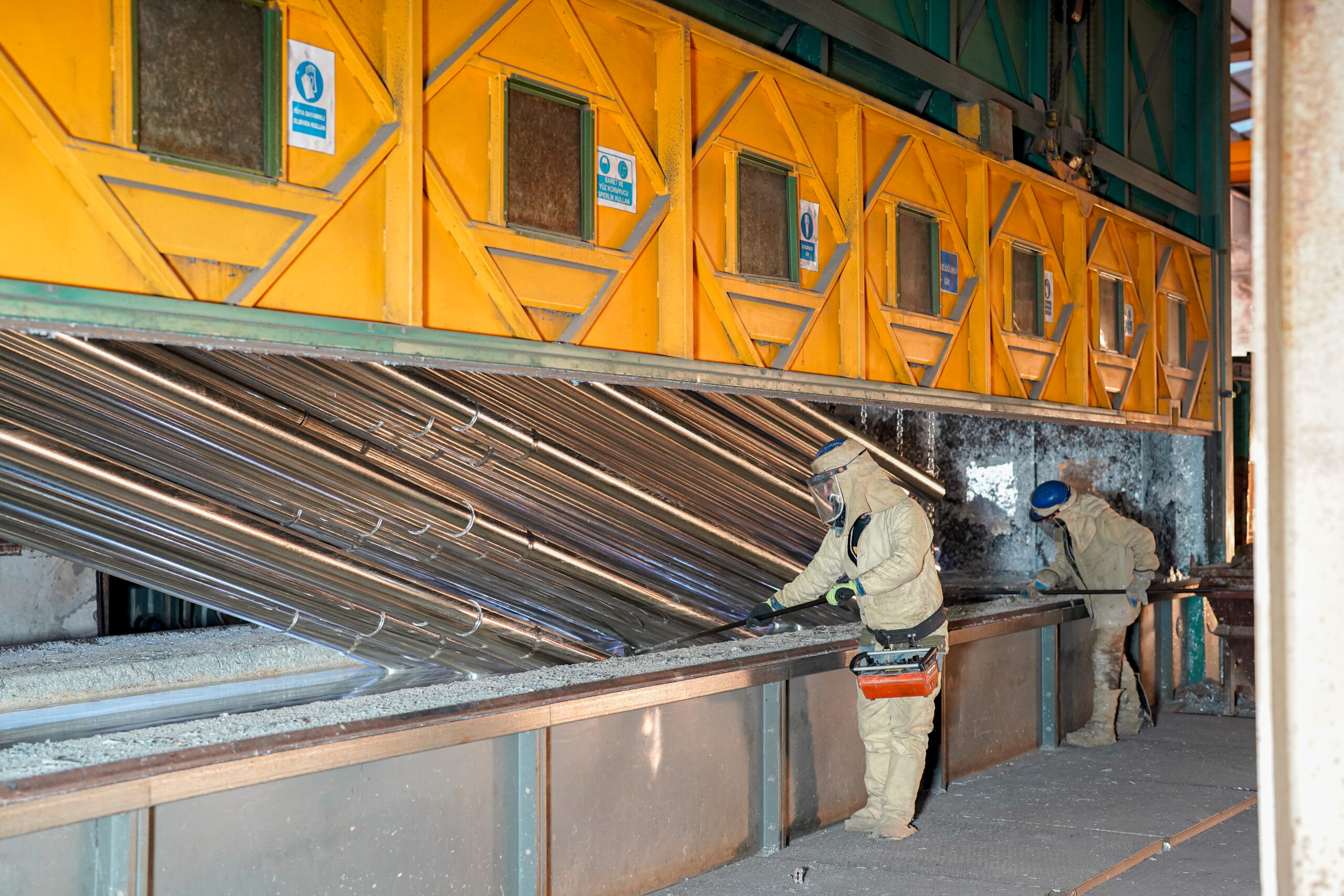
Although terms such as “galvanized paint” or “cold galvanizing” are sometimes heard in the industry, the only accepted standard in power transmission is the Hot Dip Galvanizing (Hot Dip Galvanizing) method. This is because galvanizing is not a “covering” but a metallurgical “transformation.”
Iron-Zinc Alloy Plates
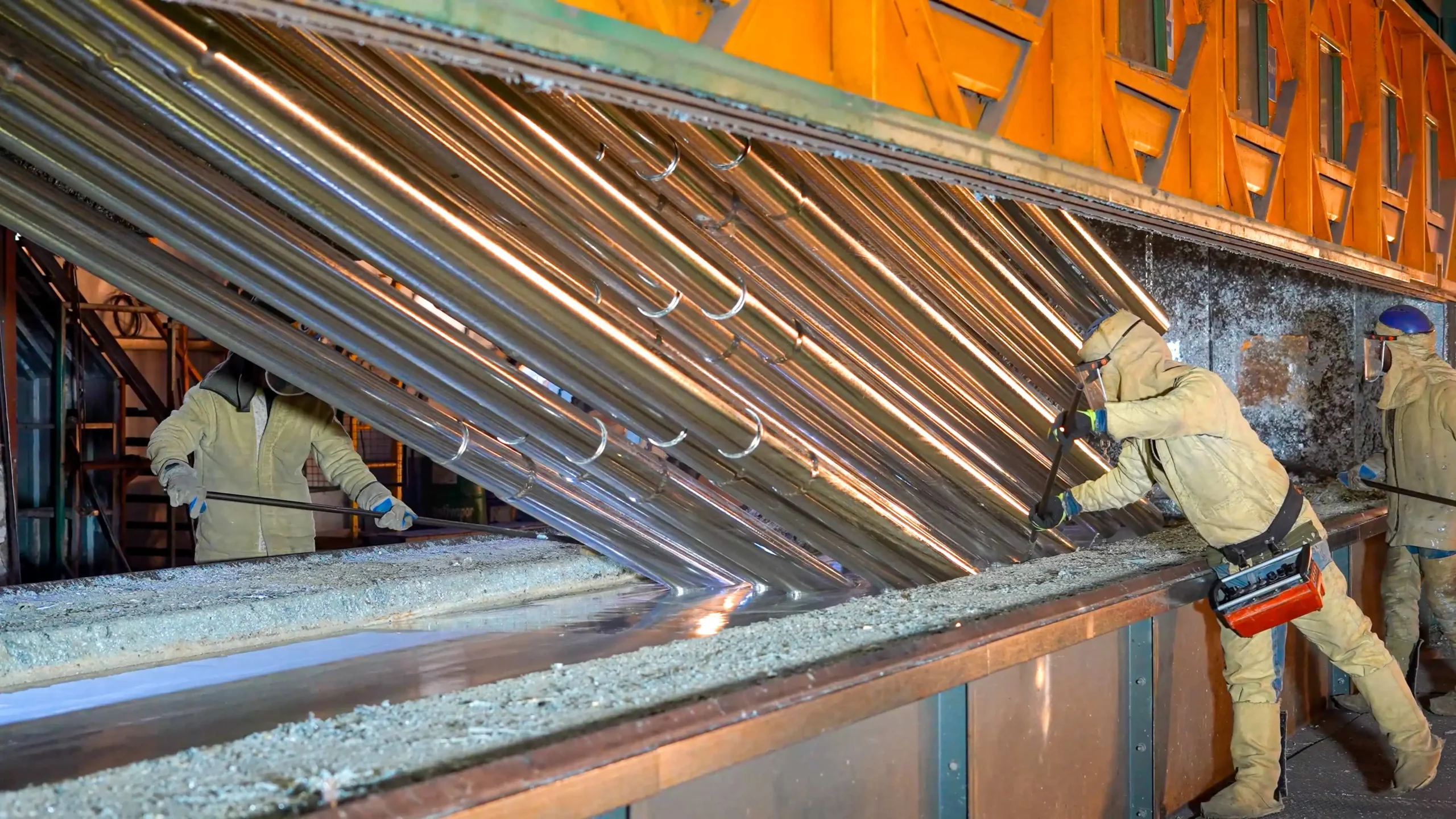
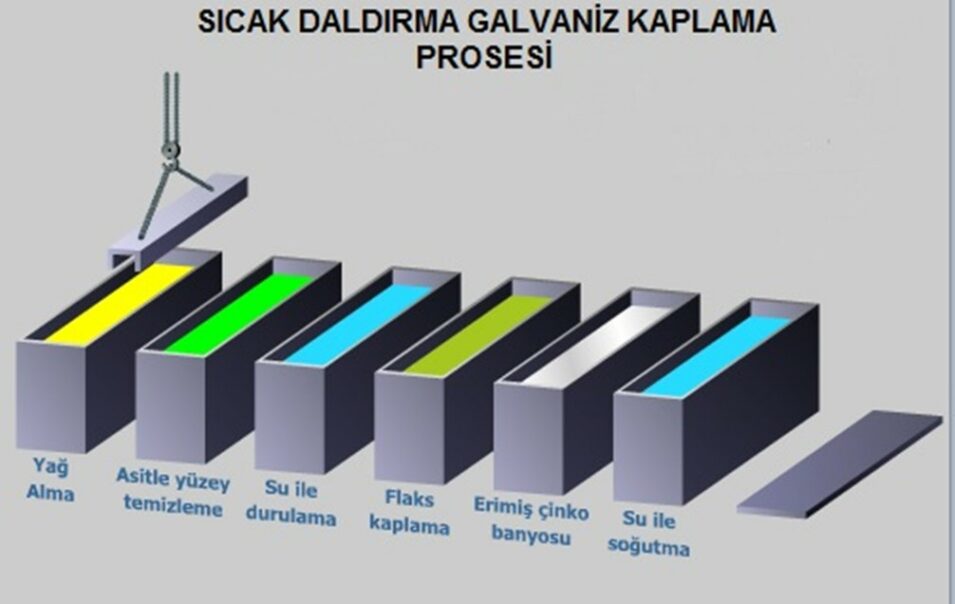
Steel entering a molten zinc bath at 450°C forms alloy layers on its surface by diffusion:
- Gamma and Delta Phases:These layers, closest to steel, are harder than the base metal (steel). This prevents the poles from eroding as they are dragged over rocky ground at the installation site.
- Eta Phase:It is the topmost layer of pure zinc, it shows shock absorbing properties.
Corner and Edge Coverage
With spraying methods such as paint, liquids escape from sharp corners due to surface tension. This results in the thinnest (weakest) paint on bolt holes and profile edges.
- Galvanizing Difference: Hot-dip galvanizingis based on the opposite law of physics. Zinc adheres just as thickly to corners and edges as it does to flat surfaces, sometimes even thicker. This is vital for frame postswhich contain thousands of bolt holes and sharp angles.
Inner Surface Protection
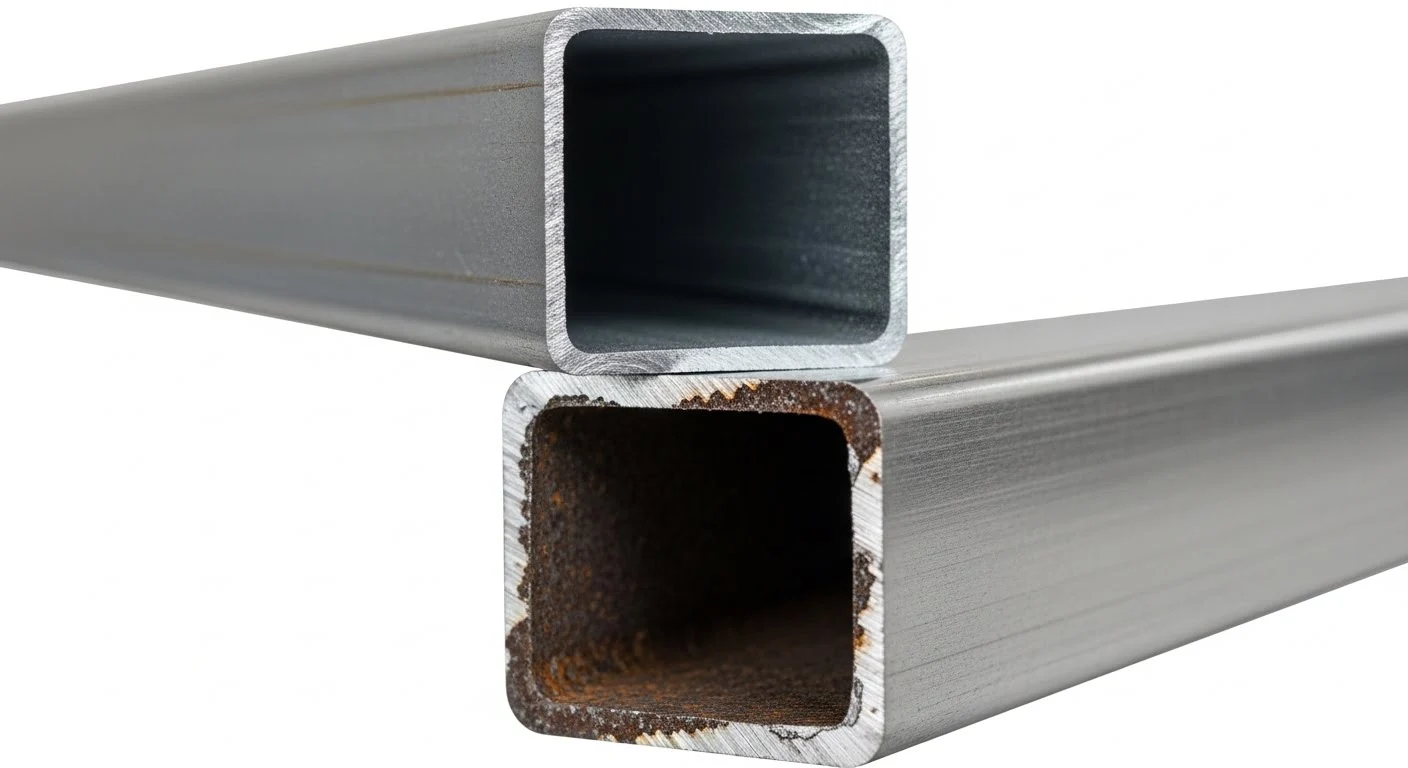
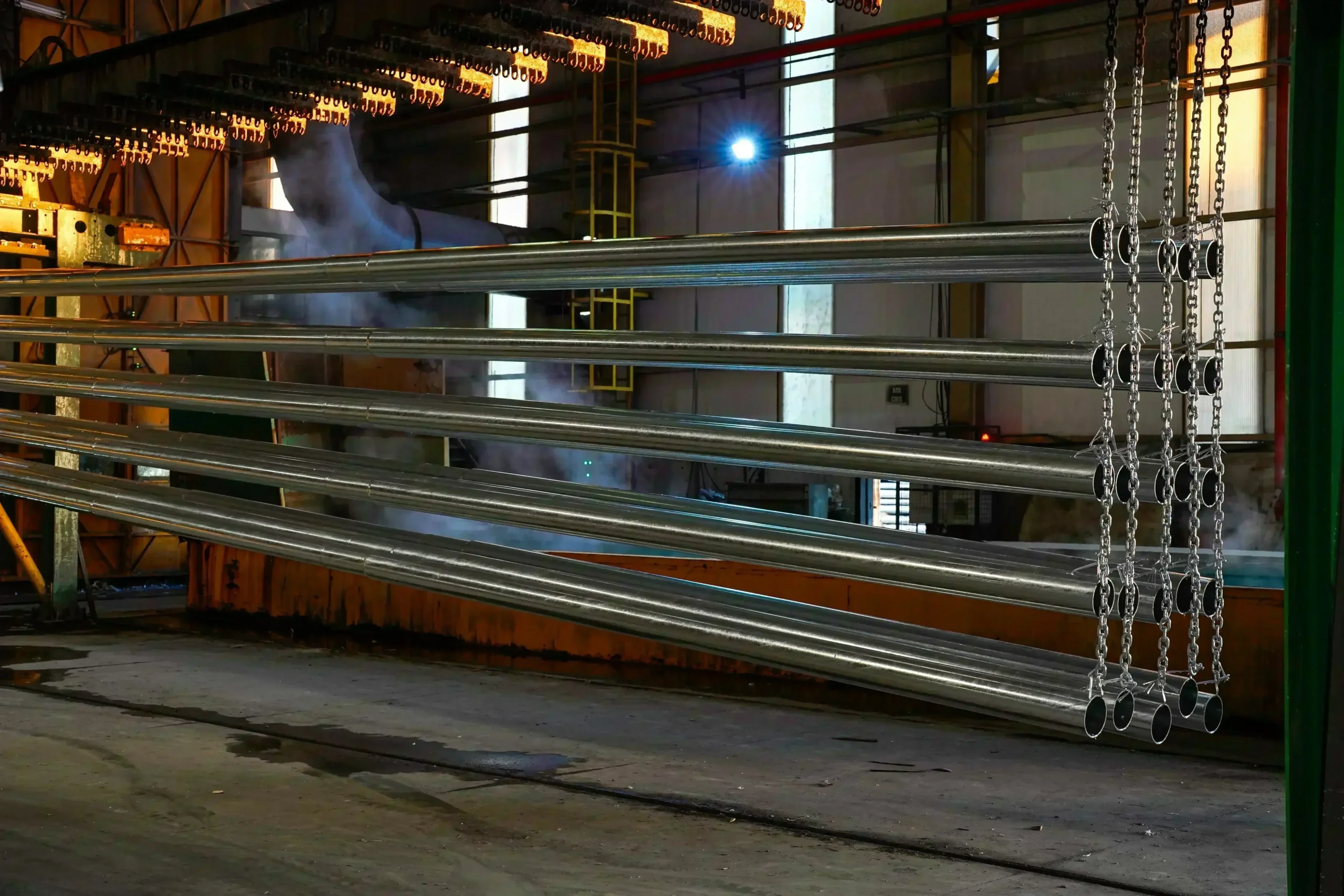
polygon poles or pipe type poles used especially in modern city transitions are hollow structures. It is impossible to paint or inspect the inside of these poles. With the dipping method, liquid zinc is filled into the pole and protects both the inner and outer surface 100%. The risk of internal decay is completely eliminated.
energy transmission lines
Why the Victim Anode Principle (Cathodic Protection) is Vital
The assembly sites of power transmission lines are the most challenging construction sites in the world. Pole parts are sometimes transported by helicopter, sometimes on mule backs, and assembled on rocks. In this process, it is inevitable that the material will be hit and scratched.
Self-Healing Mechanism
If the pole had been painted, the paint would have lifted at the first impact, exposing the steel. Rust would walk under the paint (underfilm corrosion) and blister the paint.
- The Miracle of Galvanized: Galvanized coatingEven if the steel is deeply scratched and exposed, the “Sacrificial Anode” principle kicks in. Zinc (Zn) is more electrochemically active than Iron (Fe). Zinc sacrifices itself by oxidizing as if to say “I will die, but I will keep steel alive” and closes the wound. In this way, a scratch on a pole on a mountainside is not the starting point of corrosion.
What National and International Standards Say about Galvanization in Energy Transmission Lines
The use of galvanization in energy infrastructure is not a choice, but a legal and technical obligation.
TEDAŞ and TEİAŞ Specifications
The authorities responsible for power transmission in Turkey (TEİAŞ and TEDAŞ) stipulate in their technical specifications that all steel poles, sleepers and bolts must be hot dip galvanized in accordance with TS EN ISO 1461. No ungalvanized or non-standard coated products are allowed to enter and install on site.
TS EN ISO 1461 Standard
This standard specifies what the coating thickness should be. For thick steels (6mm and above) used in energy poles, the average coating thickness is required to be 85 microns (approximately 600 g/m²).
- Global Standard: ASTM A123 in the USA and EN ISO 1461 in Europe recognize galvanizing as the only valid method for the security of energy grids.
Galvanized Application Differences in Lattice and Polygonal Poles
Power poles are divided according to their design and both test the competence of the galvanizing plant.
Small Piece Management in Lattice Poles
Lattice poles, which are frequently seen in high voltage lines, consist of thousands of small angle pieces and connection plates. These parts, and especially the connecting boltsmust be galvanized cleanly before the threads are filled. This requires high-tech centrifugal galvanizing lines.
The Importance of Single Dip in Polygon and Monopole Poles
Long-bodied (12-14 meters) polygon polesused at city crossings and in narrow spaces, strain the capacity of the galvanizing plant.
- Double Dip Risk:Facilities with insufficient pool length (e.g. 7m) dip the pole twice (Double Dip). This creates a “lap mark” in the center of the pole and can cause the pole to bend (warp) due to excessive temperature difference.
- IES Galvanized Single Dip Advantage: In plants with a capacity of 14 meters galvanizing pool, huge energy poles are dipped in one go. This ensures no seam marks on the pole surface, minimizes thermal stresses and provides uniform corrosion protection. TEDAŞ specifications also encourage single immersion where possible.
Life Cycle Cost Analysis
The most important criterion for those managing public or private sector budgets is “cost”. However, the cost here is not the “sticker price” but the “cost of ownership.”
Initial Investment vs. Operating Cost
A painted system may initially appear 10-15% cheaper. However, the paint has to be renewed every 5-7 years. In power lines, the cost of repainting can be 3-4 times the initial investment cost (labor, transportation, line shutdown).
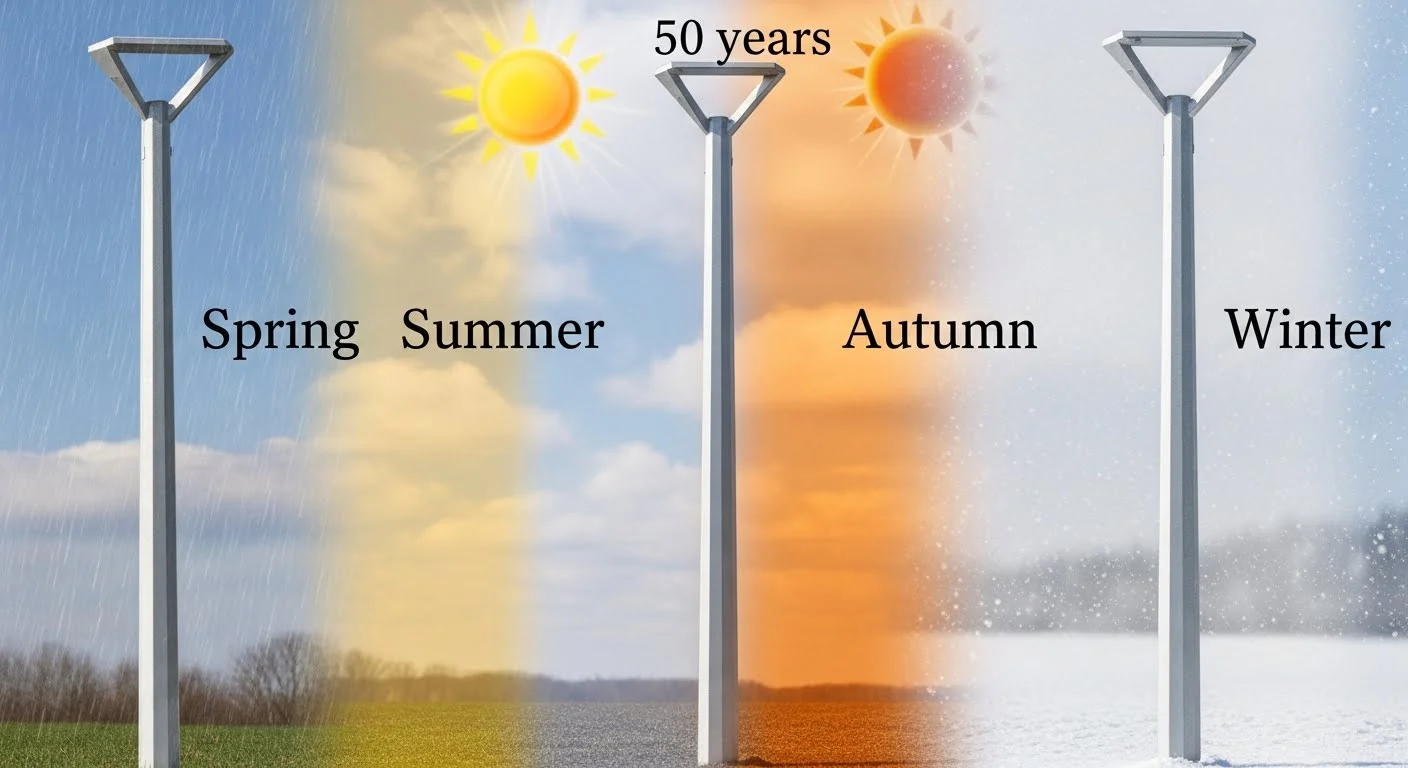
Galvanized steel poles are maintenance-free for at least 50-80 years (depending on the atmospheric class) after installation.
Opportunity Cost
Taking down a pole due to corrosion or stopping a line for maintenance is not just a repair cost. If the factories fed by that line stop working and the cities remain in darkness, it means billions of liras of economic loss. Galvaniz guarantees security of supply by minimizing this risk.
energy transmission lines
Sustainability and Environmental Impact
The infrastructure of renewable energy (RES, GES, HES) projects must also be environmentally friendly.
- 100% Recyclability:A galvanized power pole dismantled after 60-70 years of service can be melted down as scrap. Zinc and steel are separated and 100% recovered.
- Non-toxicity:Power lines often cross farmland, forests or watersheds. Unlike paints, zinc is an element that already exists in nature. The trace amounts of zinc oxide that enter the soil with rain do not leave toxic waste in the environment.
Common Mistakes and Misconceptions
- Can energy poles be painted afterwards? (Duplex System)
Yes. Especially for aircraft warning (red-white) or in very extreme corrosion (C5-M) environments, paint over galvanized (Duplex System) is applied. This increases the lifespan by 1.5 – 2.5 times.
- Is Corten (Air Impact) Steel Used in Power Lines?
Although tried in some countries, especially in humid and salty environments, the protective patina layer of Corten steel cannot stabilize and decays. Galvanization is the most guaranteed solution for every climate condition.
- Is Galvanization Sufficient for Subsoil Corrosion?
In addition to galvanizing, the stubs of the poles buried in the ground should be coated with bituminous paint or special insulation materials. Because soil acidity can be much more aggressive than corrosion in air.
No Compromise on Infrastructure Security
Energy transmission lines are the nervous system of a country. The survival of this system depends on the metallurgical integrity of the poles. Hot-dip galvanizing is the most reliable, economical and longest-lasting technology proven to provide this integrity.
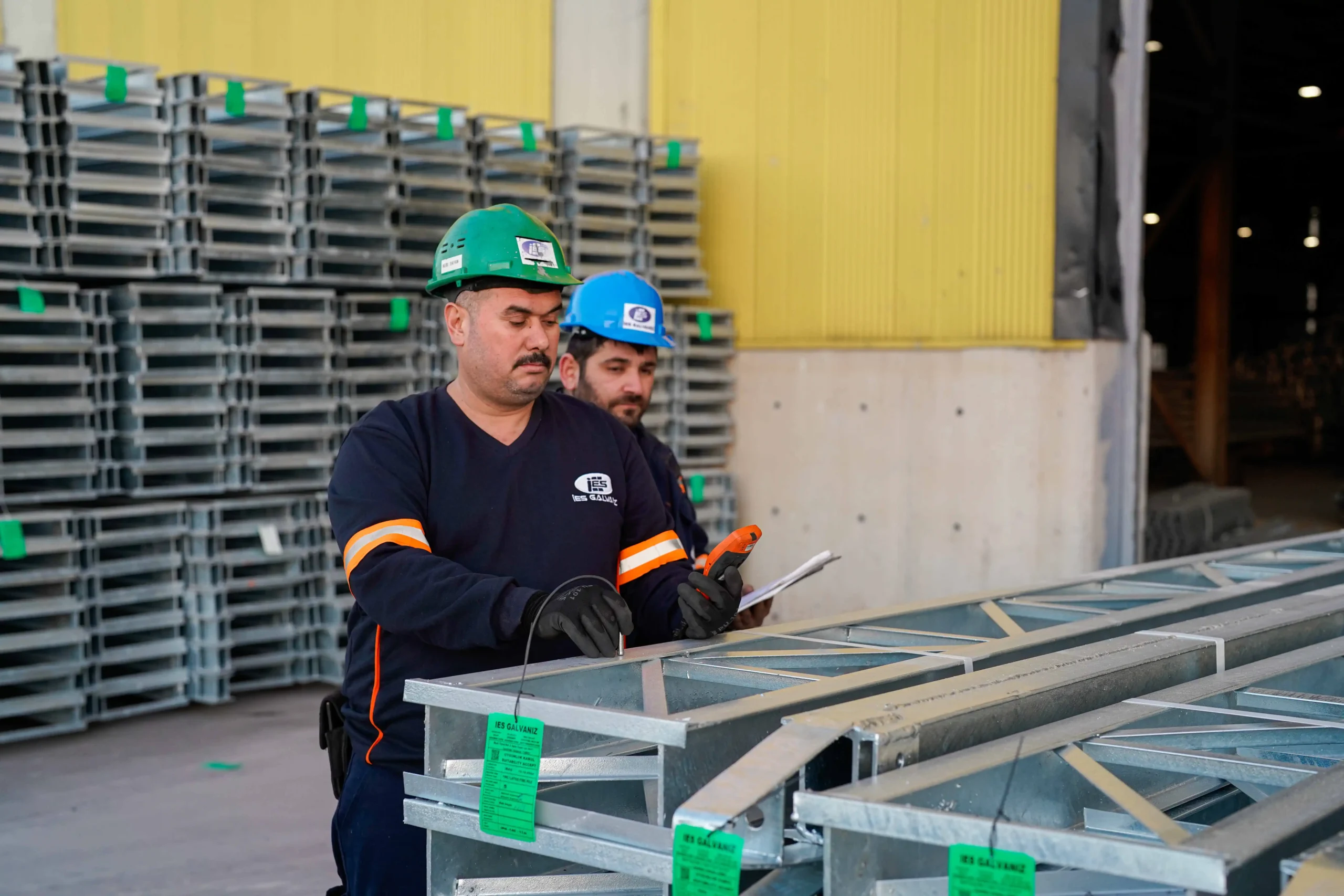
As İES Galvaniz, we add strength to Turkey’s energy infrastructure with our annual capacity of 120,000 tons, 14 meter galvanizing pool technology and TEDAŞ approved production processes. Energy transmission poles, poligon pole and switchyard steel construction for your needs, we offer production and galvanizing services in international standards.
Remember, corrosion doesn’t wait, but proper engineering stops it.